$ cat ~/dev/research.md
Department of Astronomy, University of Florida — Dr. Triana Almeyda
Working with Dr. Almeyda's group on dusty torus reverberation mapping in active galactic nuclei, a technique that uses time-delayed infrared responses of the torus to constrain AGN geometry and dust properties. I'm currently in a year-long study of convolutional methods for AGN light curve analysis, building a response-function library with the TORMAC simulation framework on UF's HiPerGator supercomputer. This research is funded by the University of Florida University Scholars Program, supporting undergraduate research toward a culminating peer-reviewed publication.
Poster Presentation
PULSAR Poster Session, Department of Astronomy, University of Florida — J. Lyle, T. Almeyda, Z. Knutson
Presented in-progress results demonstrating that the infrared response of an AGN torus to an arbitrary optical light curve can be reproduced by FFT convolution with a pre-computed response function extracted from TORMAC, closely matching direct simulation output. Showed preliminary evidence that response function shape carries torus parameter dependence, and outlined ongoing work toward a publicly released response function library enabling IR reverberation modeling without high-performance compute.
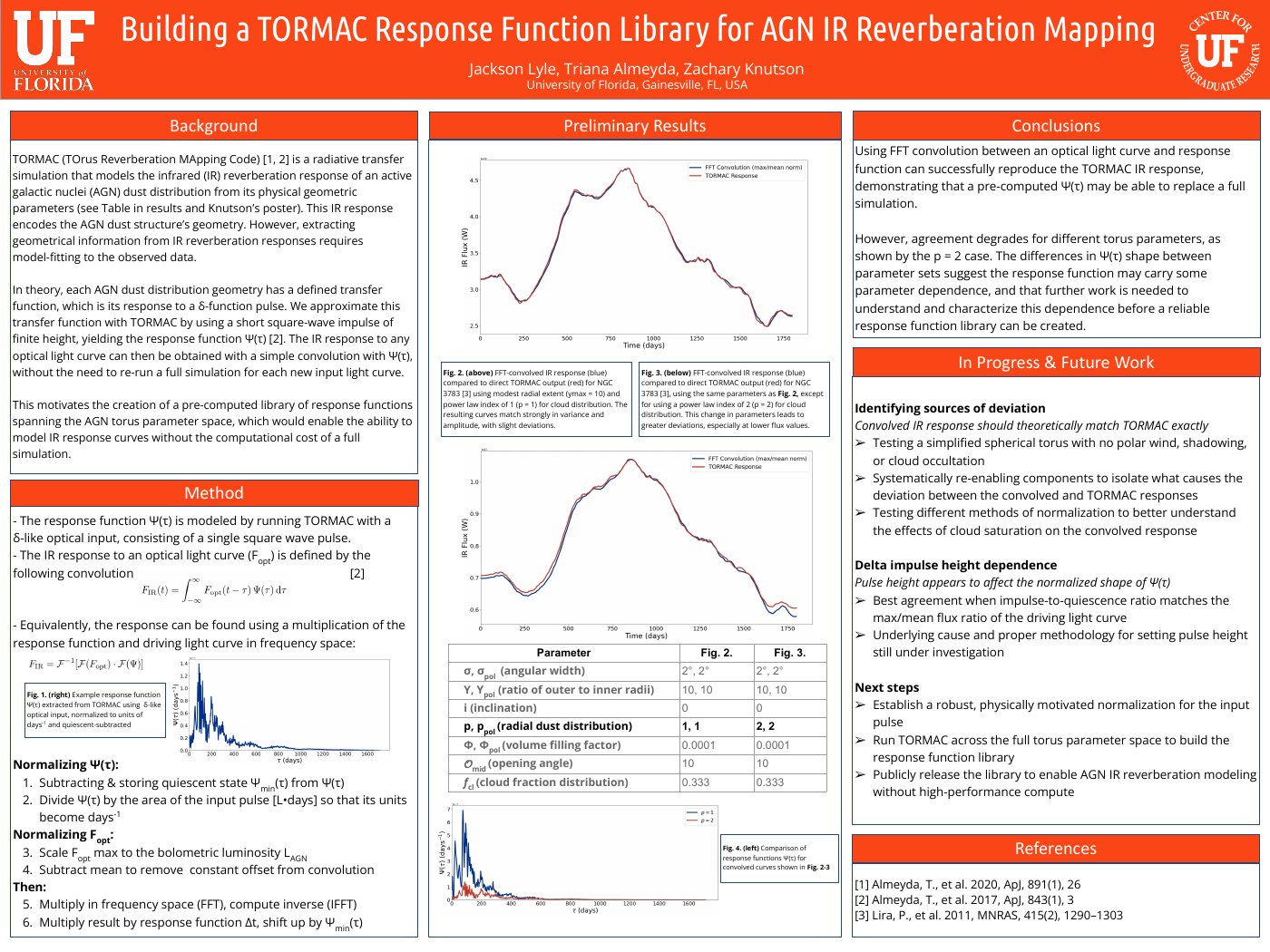 view poster (pdf) ↗
Rosemary Hill Observatory, University of Florida — RETRHO Program, led by Dr. Jamie Tayar & Dr. Triana Almeyda
Writing and maintaining code for automated calibration, reduction, and delivery pipelines that turn raw CCD frames into science-ready datasets for requesting researchers. Also operating a 14-inch research telescope and CCD system to collect observational data on requested astronomical targets, averaging approximately six hours per week, and collaborating with the university research team on observational planning and instrument use.
Academic Presentations
PHY570 Advanced Astronomy Methods, Phillips Exeter Academy
A literature synthesis examining the viability of quasars as cosmological standard candles. Covered the Lusso-Risaliti UV-X-ray luminosity relation, the construction of high-redshift Hubble diagrams, and ongoing debates around redshift evolution, large-structure anisotropy, and the data selection methods required to produce unbiased quasar samples.
PHY480 Special Topics in Astronomy, Phillips Exeter Academy
A review of cataclysmic variable systems and classical novae outburst mechanics. Covered accretion disk physics, electron degeneracy pressure, thermonuclear runaway via the CNO cycle, and photometric and spectral classification of novae through light curve morphology and FeII versus He/N type emission line analysis.